
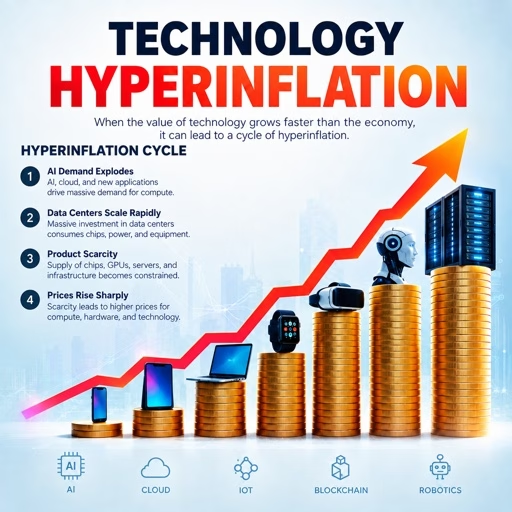
Surviving Technology Hyper-inflation
We’ve all heard the discussion about affordability and household inflation affecting everyone. But small-business owners buying technology are facing something more severe: hyperinflation in products such as computers, memory, storage, and servers.
What’s Driving the Price Spike
While general inflation is playing a part in this, it’s a small part. Tariffs are also part of the increases. However, the main culprit is the sprawling AI datacenters. They are, to use a familiar phrase, sucking all the oxygen out of the room, except instead of oxygen it is memory, storage and servers, consumed at a scale never seen before. Entire business units have been realigned to feed data centers’ voracious appetite for hardware. As an example, Crucial, which has supplied consumers and small businesses with computer memory and storage for nearly 2 decades, shutdown their consumer and small business units so it could instead redirect that production into trying to meet surging datacenter demand. That decision also suggests these companies expect the demand to continue for years.
How Bad Are the Increases?
Memory has been hardest hit. Modules that sold for $18 in 2023, are selling for nearly $300 now – if you can get them. Overall, memory has increased around 450% since late ‘23/early ’24. Storage is close behind at about a 300% increase. Servers have been hit hard too. Low end servers that are light in memory and storage have increased about 100%. High end servers heavy in memory and storage, are up between 300% and 700%; again, when you can get them.
Ripple Effects Across Your Technology
Unfortunately, memory is used in almost all technology products, forcing prices for those systems to go up as well. Video surveillance equipment, switches, Wi-Fi access points, firewalls, etc. All have seen some measure of increases, whether in the form of general price increases or surcharges. It does seem the PC manufacturers are trying to temper the price increases of desktops and laptops. Those have only seen price increases of between 50% to 150%.
Ways to Soften the Blow
So how do you mitigate these price increases? Unfortunately, there are not many options. For desktops and laptops, the most obvious answer is to keep them longer. For small businesses, you can look at secondary suppliers that buy in bulk and pass the savings, which can be substantial, on to you. For servers, extending their useful life may again be an option. Instead of retiring the server when it goes end-of-life, look at taking out a post-support or 3rd party hardware warranty on it. For memory upgrades, look at the secondary market for new or reclaimed memory; this can be significantly cheaper than buying new from retail. All of these have risks, but in this environment it’s a balance of risk vs costs.
The Cloud Isn’t a Safe Harbor
Some businesses are taking another path – one that also carries considerable risk – by moving their computing workloads to the cloud. But these are starting to see price increases too. Microsoft’s Azure just announced an upcoming 25% price increase on some of their most popular virtual servers. This is likely just the beginning. Once a business has moved its computing environment to the cloud, returning it to on-premises infrastructure can be costly, difficult and lengthy. As a result, the business may have little choice but to absorb future price increases.
When Will Prices Ease?
When will this end? Most likely, it will ease when data-center growth slows. Predicting when that will happen is difficult because AI’s power and bandwidth requirements continue to increase. There is some current decrease in the growth rate right now due to power limitations and political push back. But stabilization of datacenters will likely not be until between 2028 and 2030.
The Bottom Line
Until then, businesses will have to contend with vastly higher technology prices. The practical response is to extend the life of existing systems where it makes sense, weigh lower-cost alternatives carefully, and postpone nonessential expenses until the market stabilizes and prices begin returning toward reasonable historical levels.
📧 [email protected]
📞 +1-855-SPOTLINk (855-776-8546)
Robert Hood
CEO & Founder
SpotLink®
Author’s Note: I write my own blogs. That’s unusual. Blogs are often authored by a service and then reposted, especially in IT, or written by AI from a few key words. Instead, I choose the topics that might be of most interest to our clients and write to them – to you – directly. While it does take a little more time to write my own content, it does mean that we are well versed in the subjects I send to you. So, please always feel free to reach out to me if you have any questions or comments about anything I write, including any topics you’d like to learn more about. Thank you. – Robert Hood.
Copyright 2026 SpotLink®